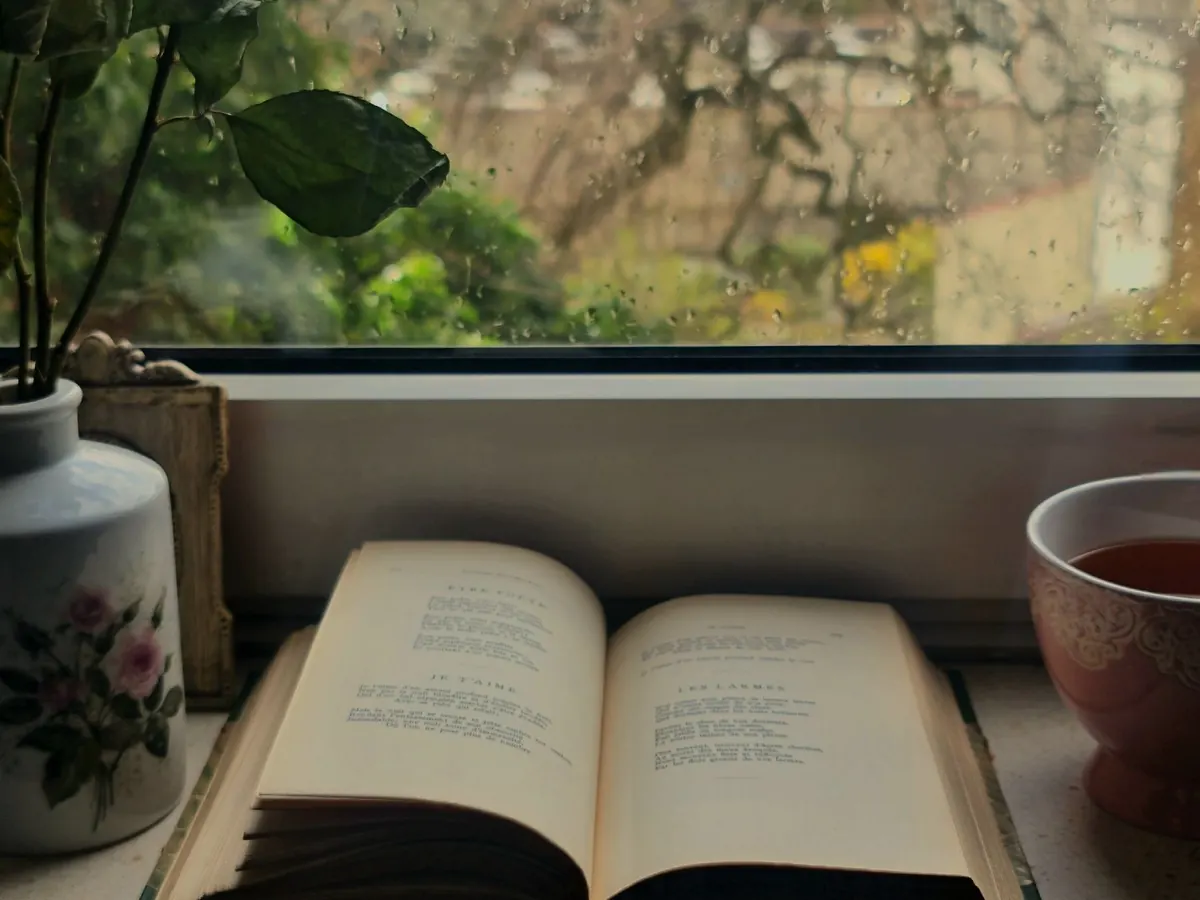
Rain in Britain rarely arrives dramatically. It arrives as a grey suggestion, then a steadiness, then a decision you have to make about your shoes. By three o'clock the light has gone the colour of a dishcloth and the afternoon has quietly closed its options down.
That is not a problem. It is a writing room with the door shut.
Below are thirty prompts built for exactly this weather: the steamed-up window, the bus shelter, the washing-up bowl, the two miles home. Some will take you ten minutes. A few will carry you to teatime. Read until one catches, then start writing before you talk yourself out of it.
Start with the Weather Itself
Before characters, before plot, get the rain right. Most writing about rain fails because it describes the idea of rain rather than the specific stuff falling past your window.
- Three speeds. Write the same street in drizzle, in steady rain and in a downpour. Same road, same hour, three paragraphs. Notice how the verbs change before the nouns do.
- Rain by consequence. Describe a downpour without using the words rain, wet or weather. Use only what it does: the gutter that overflows, the dog that refuses the doorstep.
- Caught out. A character leaves the house without a coat because the sky looked fine. Write the next forty minutes, starting at the moment the first drop lands on their forearm.
- Forecast voice. Borrow the flat, careful language of a shipping forecast and use it to describe a person's mood. Outlook: unsettled, brightening later.
- The first line. Begin with "The rain started just after..." and keep going for a full page. Do not stop to reread. Do not plan.
- Relief. Write a scene in which the rain is welcome. A garden after three dry weeks. A funeral. A match abandoned at the right moment.
Rooms, Kettles and Indoor Sounds
A rainy afternoon is mostly heard. Write the soundtrack before you write the scene.
- Kitchen inventory. List every sound a kitchen makes on a wet Sunday: the kettle's rising note, the fridge's hum, a spoon against a mug. Choose three and build a scene on nothing else.
- The window's side. Write from the window's point of view. Who presses a forehead against it? Which houses does it watch, and which does it ignore?
- Condensation. Two people draw on a steamed-up window. One writes something the other never sees. That is the whole scene.
- Appliances. The boiler, the washing machine on a spin cycle, the extractor fan. Give one of them the emotional range of a person in the room.
- One goes out, one stays. Two people, one room, one coat on the hook. Nobody says the word umbrella. Let the argument be entirely about the tea.
- Wet things. Describe a character through their damp belongings: boots by the door, coat on the radiator, the smell of wet wool.
Journeys in the Wet
The best British rainy settings are the in-between places, the ones you cannot leave until someone else says so.
- Bus shelter. Six strangers, one timetable, no bus. Give each of them one line and one object. Decide who breaks the silence first.
- Train window. Allotments, the backs of houses, a reservoir, a retail park. Write what slides past and use it to describe a character's past without ever stating it.
- The small errand. Someone walks to the shop for one item. Something happens on the way that changes the item, and the person.
- Wipers. A conversation in a parked car, timed to the windscreen wipers. One sentence per wipe. When the wipers stop, so does the talking.
- The puddle. Write a page in which a puddle decides the plot: the crossing, the soaked sock, the turn back towards home.
- Arrival. Someone comes in late and drenched. Write the room's reaction first, with no dialogue at all, then add the speech.
Routines, Rituals and Small Comforts
Rain rewrites a day. Plans fall through, the fire goes on early, and the ordinary routines start to look like ceremony.
- Heating wars. Two people disagree about whether it is cold enough. Write the argument. Keep it about the thermostat, and about everything else.
- Out of season. A seaside town in the rain: half-lit arcades, chips eaten in the wind, a pier nobody walks on. Make it a love story or a ghost story.
- The order of things. Write an instruction manual for a wet afternoon. Kettle, toast, the good mug, the chair by the window. Make it tender without saying anything tender.
- Washing line. The washing has been out for two days and it is not coming in. Write a short piece about stubbornness.
- Cancelled. A character learns the plan is off, then has the best three hours of their week. Show us the three hours, not the phone call.
- Rain lover, rain hater. Two flatmates, one window. One opens it to listen. Write the scene without either of them explaining why.
When the Rain Settles In: Longer Pieces
If the afternoon is going nowhere and you have a couple of hours spare, these prompts want length.
- Three hundred words, one room. No flashbacks, no exits, no weather report. One rainy afternoon, one room, exactly 300 words.
- Two afternoons. Write the same wet afternoon twice: once this year, once ten years earlier, in the same house.
- Notes left for each other. Tell an entire relationship through notes and messages exchanged across one wet day. No narration, no scene-setting.
- Flood. The water is rising at the bottom of the garden. Write it as a slow, ordinary emergency: sandbags, neighbours, small kindnesses, wet carpet.
- The thing the rain remembers. A quiet ghost story set on a lane where the rain always falls at the same angle.
- Four versions. The same five minutes, a person waiting at a bus stop in the rain, written four times: comedy, horror, romance, elegy. Twenty lines each.
Making the Most of a Wet Afternoon
Prompts work best when you treat them as weather rather than homework. A few things that help:
- Set a timer for fifteen minutes and do not delete a single word until it rings.
- Write by hand if the screen keeps pulling you elsewhere. Slower handwriting is often braver writing.
- Keep a wet-day notebook. The best lines in Britain are overheard in bus queues, cafés and doorways, and they evaporate fast.
- If a prompt dries up halfway, keep the image and move to the next one. Unfinished pages are still pages.
- Read your work aloud. Anything you stumble over needs cutting, not defending.
One more thing. When you have written for an hour, put the pen down, open the front door and stand there for a minute. Listen to the gutter, the tyres on the wet road, the neighbour's gate. Then go back in and write the one detail you noticed. That is usually the line the whole piece was waiting for.
Photo: Arsonela K / Pexels